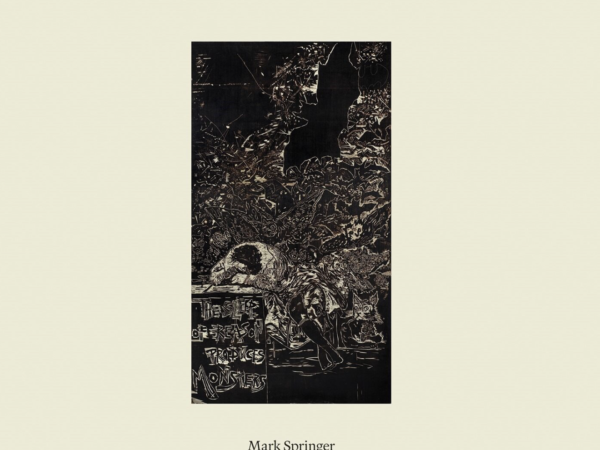
Mark Springer’s Sleep of Reason (Sub Rosa SR563) stands as a testament to the composer’s continual evolution within the realms of contemporary composition. Having established his reputation both as an expressive pianist and a founder of the boundary-breaking group Rip Rig + Panic, Springer has expanded his creative vision through works for strings, voice, and chamber orchestra, including notable recent operas. With Sleep of Reason, Springer delivers an intricately structured work of profound artistic ambition.
The album is presented in three interlinked sections, each bearing the same titular phrase. It opens with the “Sleep of Reason Quintet,” featuring the Sacconi Quartet and the distinguished vocals of Neil Tennant. Tennant’s restrained, incisive delivery complements Springer’s score, giving voice to textual material that draws inspiration from Francisco Goya’s Los Caprichos. The result is a striking alliance between music and narrative, evoking Goya’s fiercely critical perspective on late-eighteenth-century Spanish society and resonating powerfully in today’s world.
The transition to the quartet piece—“Morn, Noon, Night”—exemplifies Springer’s command of instrumental texture. Here, the Sacconi Quartet performs with remarkable cohesion and precision, their interplay infusing the music with themes that echo the earlier vocalized movements, now existing solely within the strings’ expressive spectrum. The absence of text amplifies the emotional impact, rendering the ensemble both unified and restless.
The journey culminates in the realm of solo piano, where Springer recasts and transforms the motifs introduced in earlier sections. The piano becomes a vessel for memory and transformation, distilling the preceding complexity into a series of solitary reflections. Rather than resolving the work’s underlying tensions, Springer allows his melodies to linger and dissolve, leaving the listener in a state of contemplative suspension.
Throughout Sleep of Reason, Springer resists easy resolution or melodic closure. The recurring motifs and unsettled harmonies evoke the elusive logic of dreams, as well as the uneasy boundaries between reason and imagination. The album’s nuanced interplay between light and darkness, certainty and ambiguity, speaks not only to Springer’s compositional expertise but also to his acute understanding of the human condition.
In sum, Sleep of Reason is an ambitious and intellectually rigorous work that further distinguishes Mark Springer as a significant voice in contemporary music. It is an album that challenges, unsettles, and ultimately rewards the attentive listener with its depth, subtlety, and emotional resonance.
For further information and to listen, visit: bfan.link/phantoms-and-monsters www.exit.co.uk