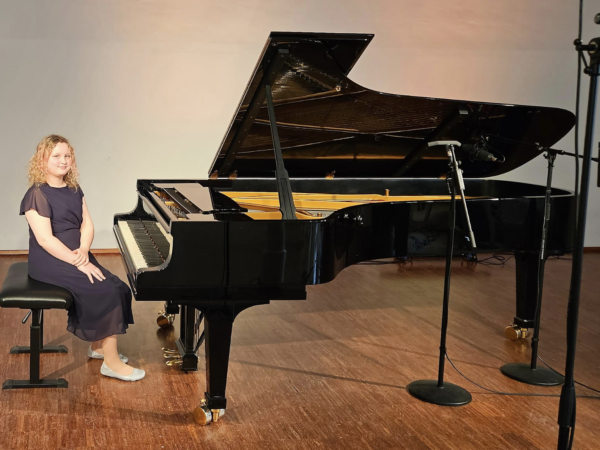
The spotlights of New York’s legendary Carnegie Hall will shine on many gifted musicians this year, but on May 23rd, the Weill Recital Hall will witness a particularly special debut: twelve-year-old Anna Smerdova. For many, it marks the rise of one of Europe’s brightest young pianists. For Anna, it is the continuation of a story woven through generations—a story that truly comes alive when her fingers touch the keys.
Anna Smerdova’s path to Carnegie Hall began not with competitions or grand performances, but in the quiet intimacy of a Prague living room in the city’s Vinohrady district. Long before she stepped onto international stages, Anna’s music was first nurtured by the gentle guidance of her grandmother, Eva Smerdova—a devoted piano teacher with decades of experience. It was Eva who sensed something extraordinary in Anna’s earliest touch of the keys, a spark that recalled the family’s rich musical heritage.
Yet Anna’s journey is bound not just to her immediate mentors. Her great-great-grandfather, Josef Bartoš, was a celebrated figure in turn-of-the-century Czech music: a composer, performer, teacher, and chronicler of his era’s mining life. Although he passed away in 1924, long before Anna’s birth, his legacy slept quietly in handwritten scores and family stories—until Anna, still a child, revived his melodies at the very instrument he once loved.
As Anna matured at the piano, her gift quickly transcended the boundaries of her home. Her remarkable ear, keen sense of rhythm, and emotional expression led to early successes at home and abroad. But there was a turning point when, at ten, she uncovered a manuscript of Bartoš’s unpublished “Waltz” in her grandmother’s library. Anna undertook the work with reverence, spending countless hours to unearth its long-silent voice.
“I feel as though he’s sitting next to me, guiding my hands,” Anna confided to her grandmother after a practice session. Her performance of her ancestor’s rediscovered piece captivated audiences and critics alike, who saw not just technical prowess but a genuine connection with the music’s soul—a bond few performers ever reach.
Her rapidly growing list of accolades—including top prizes at Italy’s International Artepiano Competition, Spain’s Franz Liszt Competition, Poland’s OPUS, Austria’s Wiener Klassik, and many others—culminated last year in her selection for the Czech Republic’s MenART academy, where she studied under Ivo Kahánek and performed at the prestigious Prague Spring Festival.
And now, as Anna prepares for her much-anticipated New York performance, she carries not only the hope of her family and her homeland but also the whispered encouragements of her ancestors. The program will include selections from the classical repertoire—alongside the world premiere of her great-great-grandfather’s “Waltz,” resurrected by her devotion.
“When I learned I would play at Carnegie Hall, my thoughts turned immediately to Josef Bartoš and my grandmother,” Anna says. “This is not just my achievement. It’s the fulfillment of a story that began generations ago, with music as the thread that ties us all together.”
In a world where success is too often counted only in medals and trophies, Anna Smerdova stands out as a musician who understands the true meaning of legacy. Through her courage, humility, and profound musical insight, she bridges the distance between a 19th-century mining town in Příbram and the world’s greatest concert halls.
On May 23rd, as Anna steps onto the Carnegie Hall stage, she will bring with her more than youth and technical skill. She will bring the spirit of a family’s musical heritage, a grandmother’s loving hand, and the living memory of a great-great-grandfather’s compositions. Each note she plays will reaffirm that music is a living bridge—a connection from past to future, and from heart to heart—resonating far beyond the confines of any one stage.
And so, the legacy continues, echoing in the hands of a small girl whose music has already touched the world.