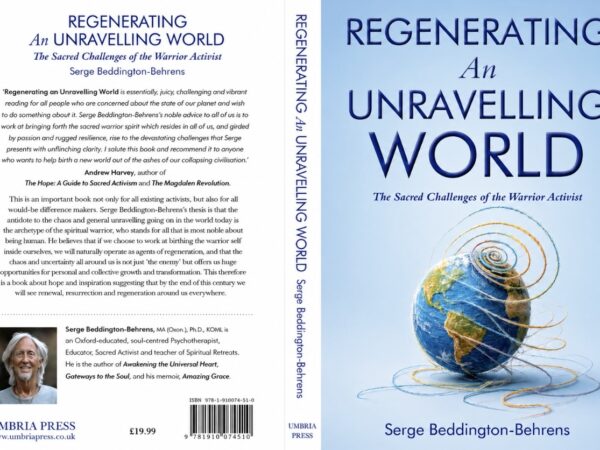
In Regenerating an Unravelling World: The Sacred Challenges of the Warrior Activist, Serge Beddington-Behrens explores this difficult question without reducing it to a simple battle between good people and bad people.
For the psychotherapist, spiritual educator and author, confronting destructive forces requires courage and action, but it also demands something less comfortable: self-examination.
The Line Between Good and Evil
It can be tempting to think of evil as something that exists entirely outside ourselves. We identify those we believe are responsible for injustice, violence or oppression and place ourselves firmly on the side of good.
Beddington-Behrens challenges this assumption.
Drawing on the idea that the dividing line between good and evil runs through the human heart, he asks readers to recognise that most people may carry aspects of darkness within themselves, particularly when they become unconscious of their own behaviour.
This does not mean excusing genuinely destructive actions. Instead, it means becoming more honest about our own vulnerabilities.
For Beddington-Behrens, this kind of self-awareness is an essential part of becoming a Warrior Activist.
Why Activists Need to Look Within
The book argues that people cannot effectively confront problems in the wider world while refusing to examine themselves.
Anger, prejudice, fear, ego and the desire to dominate can appear in anyone.
An activist may sincerely believe they are fighting for justice while becoming increasingly hostile towards anyone who disagrees with them.
That is why Beddington-Behrens sees self-reflection as part of activism rather than something separate from it.
The question becomes not simply “What evil am I fighting?”, but also “What is happening inside me as I fight it?”
For him, confronting our own shadow can develop the self-awareness and inner strength needed to take more conscious action in the world.
Love Does Not Mean Passivity
This does not mean that Beddington-Behrens believes every form of evil can be overcome simply through kindness.
In his discussion of confronting evil, he acknowledges that different situations require different responses.
Sometimes destructive behaviour needs to be exposed. Sometimes it needs to be contained. In some circumstances, people may need to take firm action to prevent harmful forces from spreading.
The challenge is knowing what response is appropriate.
This is where the qualities of the Warrior Activist become important: courage, discernment, strength and the ability to act without losing one’s humanity.
Looking Beyond the Individual
Beddington-Behrens also questions the idea that removing one destructive individual necessarily solves a problem.
A harmful leader can be a symptom of a deeper social or psychological environment.
If the mindset and systems that produced that individual remain untouched, another person may eventually take their place.
This means that confronting evil also requires looking at the conditions that allow it to develop: collective attitudes, fear, disconnection, power and unconscious behaviour.
For the Warrior Activist, the goal is therefore not simply to defeat an enemy.
It is to understand what needs to change.
The Courage to Examine Ourselves
Ultimately, Regenerating an Unravelling World presents confronting evil as both an outer and inner responsibility.
There are injustices that need to be challenged and destructive forces that cannot simply be ignored.
But the person doing the challenging must also remain willing to look inward.
That may be the more difficult form of courage.
It means standing firmly for what is right without allowing hatred to become our identity. It means recognising darkness in the world while remaining aware of our own capacity for unconscious behaviour.
For Beddington-Behrens, the Sacred Warrior is not someone who believes they are completely separate from the problems of humanity.
They are someone willing to confront those problems while continuing to work on themselves.
And perhaps that is what makes activism genuinely sacred: the fight for a better world begins with the responsibility to become a better participant in it.